

AI is expanding awareness and reach across consumer and prosumer user segments, covering B2B, B2C, C2C, and D2C domains. Awareness-to-adoption is outpacing even analysts’ expectations. The business-centric benefits are numerous, irrespective of industrial sectors. Companies such as JPMorgan Chase, Oracle, Salesforce, and SAP have realigned their customer-facing business processes by implementing multi-model business rules.
It is evident that AI is becoming the enterprise highway for future competition, commerce, and communications. Across industries, consumer-facing companies are deploying voice agents to improve customer satisfaction ratios while reducing human-driven mistakes.
OpenAI, Google Gemini, Anthropic Claude, xAI Grok, and Perplexity AI are offering competitive AI models for various enterprise and consumer use cases. When it comes to awareness, usage, and user base, OpenAI is significantly ahead of its competitors. However, this leadership comes with humongous computing costs.
Every AI service company is struggling with compute power, and OpenAI is no exception. It is also evident that OpenAI is carrying significant infrastructure and user acquisition costs on its books and must develop a business model that is more cash-flow-centric and sustainable over the long term.
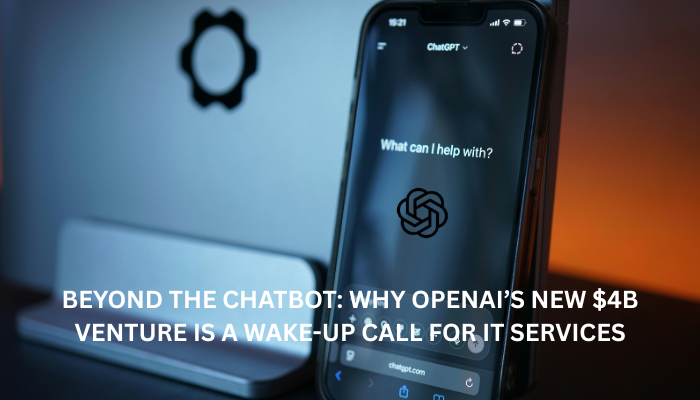
In view of this, OpenAI, on May 11, 2026, collaborated with global investor titans such as TPG, Advent International, Bain Capital, Brookfield Corporation, Goldman Sachs, Capgemini, and SoftBank Group.
The vision is to tap into the multi-trillion-dollar IT deployment and support sector, which has traditionally been the core business of Indian IT companies such as Tata Consultancy Services, Infosys, HCL Tech, Wipro, LTI Mindtree, Happiest Minds Technologies, Zensar Technologies, Birla soft, and many others.
The OpenAI collaboration is expected to target nearly 2,000 large enterprises where these investors already maintain existing relationships, along with new businesses. OpenAI would provide technical consulting, skilled resources, AI solution deployment, and managed operations.
The initiative could create an opportunity to generate free cash flow, which, in turn, may help the company move toward long-term profitability.
Instead of building the ecosystem entirely from scratch, OpenAI and its collaborators agreed to invest $4 billion to establish an AI deployment company. On May 11, 2026, OpenAI also announced the acquisition of Tomoro, a 2023-founded AI consulting and engineering company with more than 150 engineers.
On the surface, the strategy appears extremely promising. However, competing directly with companies such as Tata Consultancy Services, Infosys, HCL Tech, and Wipro may prove challenging.
These companies have spent decades developing exceptionally low-cost skill development centers and highly optimized resource cost structures. This could make it difficult for OpenAI to convince long-term enterprise customers to shift away from established Indian IT service providers.