
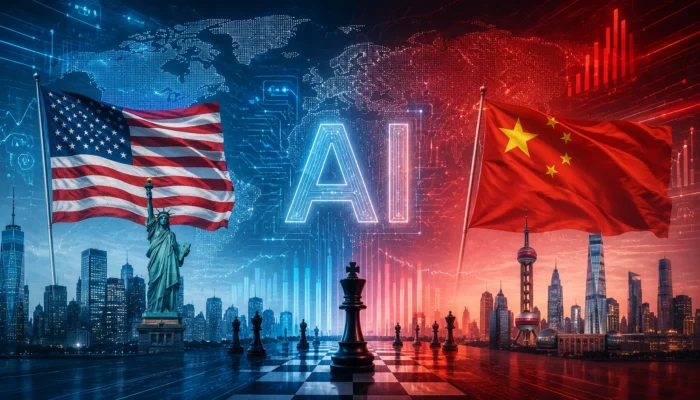
Artificial Intelligence (AI) has become one of the most important technologies shaping the future of economies, businesses, and governments worldwide. For years, the United States was widely viewed as the unquestioned leader in AI innovation, thanks to technology giants, research institutions, and startups based in Silicon Valley. However, recent global survey data suggests that international perceptions may be changing rapidly.
A new study conducted by Public First, a UK-based research organization, surveyed more than 18,000 people across 15 countries and found that many now view China as a stronger competitor—and in some regions, the leading force—in the global AI race. At the same time, concerns about job displacement, misinformation, and environmental impact are creating new challenges for AI adoption within the United States itself.
The findings highlight an important question: Is the U.S. losing its edge in the global AI competition, or is the perception gap growing faster than reality?
The survey reveals that opinions about AI leadership differ significantly from country to country. Respondents in the United States, India, Japan, and Vietnam still largely view America as the world’s leading AI power.
However, perceptions change dramatically elsewhere. In several European countries, as well as Canada and the United Kingdom, a growing number of people believe China has taken the lead in AI development.
This shift reflects China’s significant investments in artificial intelligence research, cloud infrastructure, semiconductor technology, and government-backed innovation programs. Chinese technology companies have expanded rapidly in recent years, developing competitive AI models, automation tools, and enterprise platforms that challenge the dominance of Western technology firms.
For policymakers in Washington, this growing perception presents a strategic challenge. Global confidence in technological leadership often influences investment decisions, international partnerships, and economic competitiveness.
The AI race between the United States and China extends beyond technology companies. It has become a broader geopolitical competition involving economic growth, national security, and global influence.
The United States continues to lead in several critical areas:
Meanwhile, China has accelerated its efforts through:
As both nations continue investing heavily in AI capabilities, the competition is becoming increasingly intense.
One of the biggest challenges facing AI development is regulation. Governments worldwide are trying to determine how much oversight is necessary without slowing innovation.
Supporters of stricter regulations argue that AI systems should undergo extensive testing before deployment. They believe safeguards are needed to prevent misuse, protect privacy, and reduce potential societal risks.
Others warn that excessive regulation could hinder technological progress. Some industry leaders argue that long approval processes may allow competing nations to move faster and gain a strategic advantage.
The debate has intensified as AI systems become more powerful and widely adopted. Policymakers face the difficult task of balancing innovation with public safety and accountability.
While AI continues to advance rapidly, public confidence in the technology appears to be weakening in some regions, particularly in the United States.
Many people who initially viewed AI with excitement are now expressing concerns about its broader impact on society. The survey found growing skepticism regarding how AI could affect employment, information quality, and infrastructure resources.
This trend is especially noticeable among younger adults entering the workforce. Many are uncertain about how AI will influence future career opportunities and economic stability.
In contrast, countries such as India and Singapore continue to show strong optimism about AI’s ability to drive innovation, productivity, and economic growth.
One of the most significant concerns surrounding AI is its potential impact on employment.
Unlike previous waves of automation that primarily affected manual labor, modern AI technologies are increasingly capable of performing cognitive and knowledge-based tasks. This means that professions traditionally considered secure may face disruption.
Many experts believe AI will automate repetitive work, improve productivity, and create new opportunities. However, concerns remain about how quickly workers can adapt to changing job requirements.
Recent discussions from technology leaders have intensified these concerns. Predictions about AI replacing portions of entry-level office work have generated anxiety among students, graduates, and professionals across multiple industries.
As businesses adopt AI-powered tools, workforce reskilling and education initiatives will likely become critical components of economic policy.
Another growing concern involves the spread of AI-generated content.
Advanced AI systems can now create highly realistic images, videos, audio recordings, and written content. While these capabilities offer exciting creative opportunities, they also raise serious concerns about misinformation and digital manipulation.
Deepfakes and synthetic media have become increasingly sophisticated, making it more difficult for people to distinguish between authentic and fabricated content.
As AI-generated media becomes more widespread, governments, technology companies, and regulators face increasing pressure to develop safeguards that protect information integrity while preserving innovation.
The rapid expansion of AI infrastructure has also created new environmental concerns.
Training and operating advanced AI models requires enormous computing power. Data centers consume significant amounts of electricity and often rely on extensive cooling systems to maintain operations.
Public awareness of AI’s energy demands has increased dramatically over the past two years. Communities are becoming more concerned about how large-scale data center projects may impact local power grids, water resources, and utility costs.
Several regions have already experienced debates over new AI infrastructure projects. As AI adoption grows, energy efficiency and sustainable computing practices will become increasingly important topics for both governments and technology providers.
The future of AI development will not depend solely on technological breakthroughs. Public acceptance and trust will play an equally important role.
If people believe AI primarily creates risks such as job losses, misinformation, and environmental strain, support for rapid expansion could weaken. On the other hand, if organizations demonstrate responsible innovation and tangible benefits, public confidence may improve.
Trust will likely become one of the most valuable assets in the next phase of AI adoption.
Companies that prioritize transparency, ethical development, and responsible deployment may be better positioned to maintain public support while continuing to innovate.
The global AI race is far from over. The United States remains a major force in artificial intelligence, with leading technology companies, research institutions, and investment ecosystems. At the same time, China continues to accelerate its progress through strategic investments and large-scale technology initiatives.
The competition is no longer just about building better algorithms. Success will depend on a nation’s ability to balance innovation, regulation, economic growth, and public trust.
The countries that effectively address workforce concerns, misinformation challenges, and infrastructure demands may ultimately gain the strongest long-term advantage.
The latest global survey highlights a significant shift in how people perceive AI leadership around the world. While the United States remains a dominant force in artificial intelligence, many international audiences increasingly view China as an equally powerful—or even leading—competitor.
At the same time, rising concerns about job displacement, misinformation, and environmental impact are creating new challenges for AI adoption within the U.S.
As the AI revolution continues, the real measure of success may not be which country develops the most advanced technology first. Instead, it may be which nation can successfully integrate AI into society while maintaining public trust, economic opportunity, and responsible innovation.