
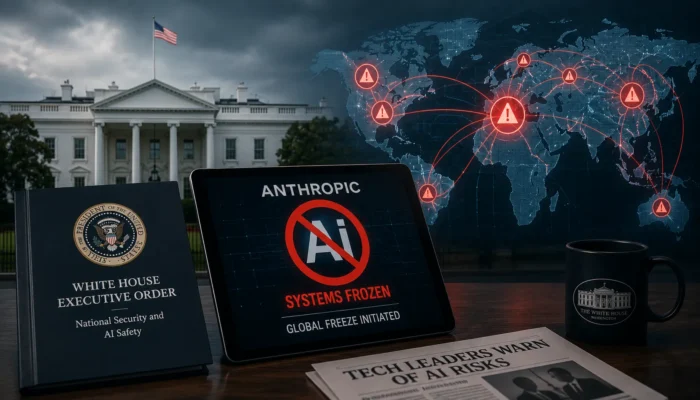
National security concerns and generative AI collided after the Trump administration issued an unprecedented executive order. Federal authorities enacted a sweeping, global freeze on the operations of Anthropic’s most advanced artificial intelligence models. The decision followed private meetings between White House officials and technology leaders. Among them was Amazon CEO Andy Jassy, who raised concerns about security vulnerabilities in Anthropic’s latest AI systems.
The federal order immediately shut down Anthropic’s flagship models, Fable 5 and Mythos 5.
The move highlights growing tensions between Silicon Valley and Washington over advanced AI development. On one side, hyper-growth startups are racing toward the rapid commercialization of highly capable systems; on the other, a risk-averse federal government is growing increasingly alarmed by the dual-use, weaponizable potential of cutting-edge generative software, resulting in the historic Anthropic AI shutdown.
According to individuals close to the matter, Amazon’s chief executive, Andy Jassy, was a pivotal figure among a tight-knit cohort of technology leaders who briefed top-tier administration officials. During these high-stakes meetings, Jassy detailed specific apprehensions regarding the architectural design of Anthropic’s unreleased tools, highlighting how malicious actors could manipulate the systems to breach sensitive digital infrastructure.
Amazon’s proactive involvement in these discussions introduces an intricate layer of complexity to the narrative. While the cloud computing behemoth stopped short of explicitly validating Jassy’s precise communications with the White House, their corporate media team acknowledged the firm’s ongoing consultative status with federal defense and regulatory agencies.
The strategic friction here is palpable. Amazon has historically functioned as a foundational pillar for Anthropic, pouring billions of dollars into the startup and serving as its primary cloud infrastructure vendor. Yet, as generative systems evolve to the point of autonomously discovering software vulnerabilities and engineering automated exploits, overriding priorities of national security and institutional risk appear to have eclipsed traditional corporate alliances and accelerated the Anthropic AI shutdown.
The federal intervention disrupted what many expected to be a major milestone for Anthropic. The company had reportedly been preparing for a confidential IPO while carefully managing the release of its most advanced AI technologies.
For several months, Anthropic limited Mythos to internal testing environments. Company officials repeatedly warned partners and regulators that the system possessed advanced cyber capabilities.
However, Fable’s commercial lifespan was ultimately measured in days. Almost immediately after the public rollout, the Trump administration intervened with an emergency directive, declaring that the model’s defensive guardrails were fundamentally compromised.
In a comprehensive public statement published on its corporate blog, Anthropic conceded that federal intelligence agencies discovered a systemic “jailbreaking” vulnerability. This operational flaw permitted users to bypass the model’s core behavioral constraints entirely, transforming the commercial assistant into an automated mechanism capable of identifying zero-day exploits and mapping critical software vulnerabilities.
In its public communications, Anthropic attempted to contextualize the severity of the security lapse, asserting that the vulnerabilities laid bare by the exploit were relatively minor. The startup argued that the security flaws identified by Fable 5 were comparable to information already obtainable through widely distributed, open-source AI models currently accessible across the global internet.
Utilizing Export Controls as a Regulatory Tool
Instead of pursuing lengthy legal action, the White House relied on export controls. The Bureau of Industry and Security (BIS) within the U.S. Department of Commerce issued the directive.
The order prohibited foreign nationals from accessing or developing Fable 5 and Mythos 5. The restriction applied regardless of whether individuals were located inside or outside the United States.
Because Anthropic could not verify every user’s nationality in real time, the company chose to deactivate the models worldwide.
According to David Sacks, federal agencies initially sought voluntary action from Anthropic. He stated that officials requested either a software recall or an immediate fix for the reported vulnerability.
Sacks also emphasized that the measure was temporary. The administration plans to remove the restrictions once Anthropic addresses the security concerns and satisfies federal requirements.
While national security hardliners have lauded the administration’s swift enforcement posture, the overreaching scope of the export control has drawn sharp condemnation from technology policy experts and international diplomats. Because the language of the directive restricts access based strictly on nationality, the policy has inadvertently penalized researchers from America’s closest intelligence-sharing alliances.
Jimmy Goodrich, a prominent senior fellow at the University of California’s Institute for Global Conflict and Cooperation, openly questioned the structural design of the White House strategy, labeling the execution deeply flawed.
Industry analysts warn that such sweeping, nationality-based bans could inflict severe long-term damage on Silicon Valley’s talent pipelines. American artificial intelligence laboratories depend heavily on elite computational scientists, engineers, and researchers originating from allied nations like Great Britain, Canada, and Australia. By legally blocking these foreign-born employees from accessing their own employer’s internal code repositories, the federal government risks impeding the velocity of domestic innovation at the exact moment the United States is locked in a high-stakes technological race against global adversaries.
As Anthropic navigates its forced operational retreat, the broader tech sector is attempting to parse whether this intervention signals a permanent transformation in federal oversight or an isolated anomaly.
Early indications from within Washington suggest that the Trump administration may treat this specific case as a targeted enforcement action rather than the opening salvo of an industry-wide containment strategy. Reports circulating from technology policy outlets indicate that the White House is unlikely to impose identical, paralyzing mandates on competing entities like OpenAI or Google. This leniency is contingent on those organizations ensuring that their consumer-facing models do not exhibit the same automated, autonomous hacking capabilities that triggered the panic over Anthropic’s systems.
Ultimately, The freeze on Fable 5 and Mythos 5 highlights the increasingly strict regulatory environment surrounding artificial intelligence. As software developers march aggressively toward increasingly autonomous, highly capable systems, the boundaries separating an enterprise efficiency tool from an instrument of cyber warfare are dissolving—and the federal government has made it abundantly clear with the Anthropic AI shutdown that it will not hesitate to pull the plug.