
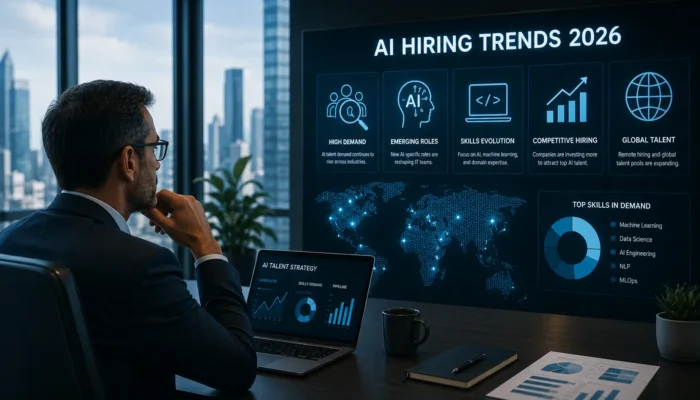
Artificial Intelligence (AI) is no longer an emerging technology it has become a critical business driver across industries. From automating operations to improving decision-making, AI is transforming how organizations compete and grow. As a result, understanding AI Hiring Trends 2026 has become essential for Chief Information Officers (CIOs) looking to build future-ready teams.
Organizations worldwide are increasing investments in AI technologies, creating unprecedented demand for skilled professionals who can develop, deploy, and manage AI-driven solutions. This article explores the most important AI Hiring Trends 2026 that every CIO should know to stay ahead in an increasingly competitive market.
One of the biggest AI Hiring Trends 2026 is the continued growth in demand for AI professionals. Businesses across healthcare, finance, manufacturing, retail, and technology are competing aggressively for qualified AI talent.
Organizations need specialists who can create intelligent systems, analyze data, and optimize business processes. As AI adoption accelerates, positions related to machine learning, data science, and AI engineering remain among the fastest-growing roles globally.
Industry reports indicate that companies are significantly increasing AI budgets, making AI recruitment a top priority for business leaders and CIOs.
Among the leading AI Hiring Trends 2026, the demand for AI engineers continues to rise. These professionals are responsible for designing, building, testing, and deploying AI-powered applications that support business objectives.
As organizations move from AI experimentation to full-scale implementation, experienced AI engineers are becoming indispensable.
Another major development shaping AI Hiring Trends 2026 is the emergence of hybrid roles that combine technical expertise with business knowledge.
Today’s organizations need professionals who understand both AI technologies and strategic business goals.
AI Product Managers bridge the gap between technical teams and business stakeholders. They ensure AI initiatives deliver measurable business outcomes and align with organizational objectives.
With the growth of generative AI, Prompt Engineers have become increasingly valuable. These professionals optimize AI interactions to improve the quality, accuracy, and relevance of AI-generated content.
AI Solution Architects design enterprise AI strategies and integrate AI technologies into existing systems, ensuring scalability and business alignment.
These hybrid positions are becoming essential as organizations seek practical AI solutions that generate real business value.
As AI adoption expands, businesses face growing pressure to implement AI responsibly and ethically. This shift represents one of the most significant AI Hiring Trends 2026.
Governments and regulatory bodies worldwide are introducing new AI governance frameworks, creating demand for specialized roles such as:
These professionals help organizations maintain transparency, fairness, security, and compliance while minimizing AI-related risks.
Job displacement remains a common concern in discussions about AI. However, current AI Hiring Trends 2026 suggest that AI is primarily transforming jobs rather than eliminating them.
AI systems excel at automating repetitive and data-intensive tasks, allowing employees to focus on strategic activities requiring human judgment, creativity, and critical thinking.
For example, AI can process massive datasets in seconds, but human professionals are still needed to interpret findings, make decisions, and develop business strategies.
The future workplace will increasingly rely on collaboration between humans and AI systems rather than direct replacement.
One of the most important AI Hiring Trends 2026 is the growing emphasis on AI literacy across all business functions.
AI knowledge is no longer limited to developers and data scientists. Employees throughout organizations are using AI-powered tools to improve productivity and efficiency.
As AI becomes embedded in everyday workflows, professionals with AI literacy will have a significant competitive advantage.
Successful candidates in today’s AI job market must combine technical expertise with strong interpersonal and leadership skills.
According to current AI Hiring Trends 2026, organizations increasingly prefer professionals who can combine technical capabilities with business understanding.
A notable shift in AI Hiring Trends 2026 is that AI recruitment is no longer restricted to IT departments.
As AI becomes a standard business capability, hiring demand will continue expanding across departments and industries.
To stay competitive, CIOs must build balanced and adaptable AI teams. Success requires more than simply hiring technical specialists.
In addition, investing in employee training and upskilling programs is critical. Upskilling existing employees can help close talent gaps, accelerate AI adoption, and improve workforce readiness.
By aligning recruitment strategies with emerging AI Hiring Trends 2026, CIOs can position their organizations for long-term success.
The latest AI Hiring Trends 2026 reveal a workforce shift toward specialized AI expertise, hybrid business-technology roles, and responsible AI governance. Organizations are actively seeking professionals who can develop innovative AI solutions while ensuring compliance and business alignment.
For CIOs, the question is no longer whether to invest in AI talent it is how quickly they can build teams capable of driving AI transformation. Companies that act now and invest in the right skills will be best positioned to lead in the AI-powered future.