
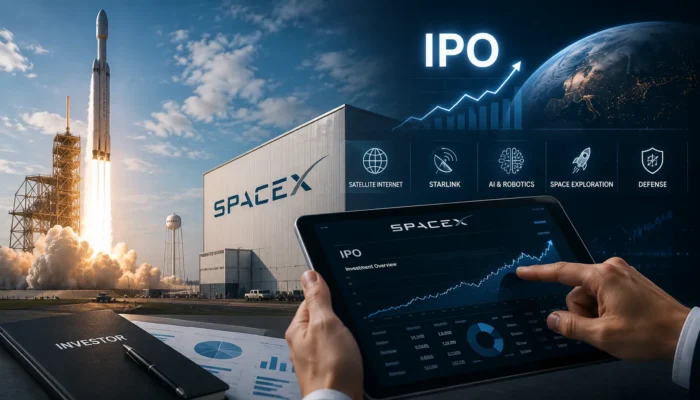
Whenever the much-anticipated SpaceX IPO arrives, analysts will naturally focus on revenue growth, Starlink subscriptions, launch contracts, profitability, and valuation metrics. Yet limiting the discussion to financial numbers alone may overlook the most valuable asset associated with the company.
That asset is not a rocket, a satellite network, or even a launch contract.
Elon Musk belongs to that small category.
What makes Musk unique is not merely his success but the pattern behind it. Throughout his career, he has repeatedly demonstrated an ability to recognize transformational trends before they become widely accepted. Long before electric vehicles became mainstream, Tesla was investing heavily in battery technology, software integration, and manufacturing capabilities. Long before private space exploration became commercially viable, SpaceX was attempting to solve one of the industry’s biggest challenges: the cost of access to space.
For decades, rockets were viewed as disposable machines. Musk challenged that assumption and pursued a solution that many considered unrealistic. Today, reusable launch systems have fundamentally altered the economics of commercial spaceflight. What was once viewed as an impossible engineering challenge has become a competitive advantage that reshaped an entire industry.
This achievement offers an important lesson for investors.
The market often rewards innovation, but it rewards execution even more. Vision without delivery creates headlines. Vision combined with execution creates industries.That distinction helps explain why investor confidence in Musk remains remarkably strong despite the scale and complexity of the projects he undertakes.
His leadership style is rooted in first-principles thinking, a management philosophy that focuses on questioning assumptions rather than accepting industry norms. This approach has enabled his companies to challenge conventional wisdom across automotive technology, aerospace engineering, artificial intelligence, and advanced manufacturing.
More importantly, it has created a culture capable of pursuing solutions that competitors often dismiss as impractical.
The story of investor confidence becomes even more compelling when viewed through the lens of wealth creation. Tesla’s journey from a controversial startup to a global technology leader generated substantial value for long-term shareholders. The company’s success was not solely a result of electric vehicle adoption. It reflected investors’ growing belief that Musk possessed a unique ability to commercialize breakthrough technologies and scale them into globally relevant businesses.
Years before AI became the dominant theme in global technology discussions, Musk was publicly emphasizing its transformative potential. Although he is no longer associated with OpenAI, his early involvement highlighted his awareness of the opportunities and risks surrounding advanced AI systems. Today, his investments in AI infrastructure and next-generation computing capabilities suggest a similar conviction about the future importance of computational resources.
As demand for artificial intelligence accelerates, access to high-performance computing is increasingly emerging as a critical competitive advantage. The companies capable of securing, building, and efficiently deploying large-scale compute infrastructure could become key beneficiaries of the AI revolution. Musk’s willingness to commit billions toward this ecosystem indicates his belief that compute capacity may become as strategically important in the AI era as energy infrastructure was during previous industrial revolutions.
Whether that prediction proves entirely accurate remains to be seen. However, investors have learned that dismissing Musk’s long-term technology forecasts has often been an expensive mistake.
Another factor contributing to investor confidence is his unusual level of mental resilience. Business history is filled with leaders who became conservative after achieving success. Musk has generally taken the opposite path. Rather than protecting previous achievements, he consistently pursues larger and more complex opportunities. Success at Tesla did not reduce his appetite for risk. Progress at SpaceX did not slow investment in artificial intelligence. This relentless pursuit of future opportunities reflects a mindset that many investors find difficult to quantify but impossible to ignore.
When investors evaluate SpaceX, they are undoubtedly assessing launch economics, satellite connectivity, and future growth opportunities. At the same time, they are also evaluating a founder whose career has been defined by technological disruption, operational discipline, and a willingness to tackle problems that others avoid.
This distinction may ultimately become one of the defining characteristics of a future SpaceX public offering.
Investors will certainly be purchasing shares in a company that has transformed commercial spaceflight. Yet many may also be investing in something less tangible but equally powerful: confidence in a leader who has repeatedly demonstrated an ability to identify the next frontier before the rest of the market arrives.
That confidence, earned through years of execution rather than promises, may prove to be one of the strongest drivers of demand when SpaceX eventually enters public markets.
The central question surrounding a future SpaceX IPO, therefore, may not be whether investors believe in rockets, satellites, or space exploration.
It may be whether they continue to believe in Elon Musk’s extraordinary ability to turn ambitious ideas into industries that reshape the future.