
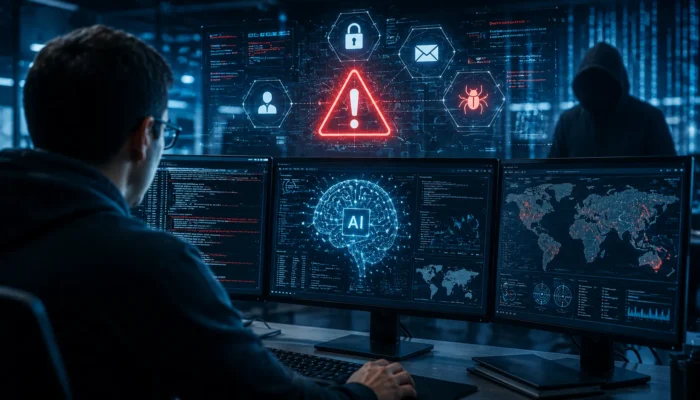
Artificial Intelligence is transforming industries at an unprecedented pace, and cybersecurity is no exception. While AI has become an essential tool for detecting cyber threats, automating security operations, and improving incident response, the latest generation of AI models has also introduced new concerns about how powerful these systems could become in the hands of attackers.
Recent discussions within the cybersecurity community have focused on advanced AI models capable of identifying software vulnerabilities, analyzing source code, and performing complex security assessments. These capabilities have raised an important question: Are modern AI models becoming a genuine cybersecurity threat, or is the concern largely driven by industry hype?
The answer lies somewhere in between. AI is undoubtedly becoming more capable, but its impact depends largely on how organizations prepare, secure their systems, and responsibly deploy these technologies.
Unlike traditional automation tools, modern AI systems can understand programming languages, analyze millions of lines of source code, recognize security weaknesses, and recommend potential fixes within minutes.
These capabilities significantly reduce the amount of time required for software security testing.
For cybersecurity professionals, this represents a major productivity improvement. However, these same capabilities could also be exploited by cybercriminals.
One of the biggest concerns surrounding modern AI is its growing ability to perform tasks traditionally carried out by experienced security researchers.
Advanced AI models can rapidly analyze software, identify weaknesses, and even explain how those vulnerabilities might be exploited.
Although these systems do not independently launch cyberattacks, they can dramatically accelerate the reconnaissance and research phase of hacking.
This doesn’t necessarily mean AI replaces skilled hackers. Instead, it makes sophisticated techniques more accessible and much faster to execute.
Cybersecurity has become a matter of national security.
Banks, healthcare providers, government agencies, and critical infrastructure operators depend on secure digital systems every day. If AI can identify vulnerabilities significantly faster than traditional tools, organizations must strengthen their defenses before malicious actors gain access to similar capabilities.
Financial institutions are especially concerned because cyberattacks targeting payment systems, banking infrastructure, and customer data continue to rise globally.
The goal is not to stop AI innovation but to ensure its responsible development.
Despite growing concerns, AI is already providing enormous value to cybersecurity professionals.
Security teams increasingly rely on AI-powered platforms to identify attacks faster than humans can manually investigate.
Common defensive applications include:
AI continuously analyzes network traffic and detects suspicious activities before attackers can cause significant damage.
Modern AI tools automatically scan applications and infrastructure to identify security weaknesses.
AI helps Security Operations Centers (SOCs) prioritize alerts, reduce false positives, and accelerate incident response.
Machine learning models rapidly classify malicious software and identify emerging threats.
AI monitors user behavior to detect compromised accounts and unusual login activities.
Although AI models are becoming increasingly capable, independent cybersecurity researchers emphasize that many public claims still require broader validation.
Most organizations have not yet independently tested the latest AI systems under real-world enterprise environments.
However, attacking well-designed, properly secured enterprise systems remains considerably more difficult.
Strong cybersecurity fundamentals continue to provide the best defense.
Perhaps the biggest misconception is that advanced AI makes traditional cybersecurity practices obsolete.
Organizations that maintain good cybersecurity hygiene remain significantly better protected, regardless of AI advancements.
Rather than fearing AI, businesses should use it to strengthen their security posture.
Recommended best practices include:
Verify every user and device before granting access to sensitive resources.
Regular software updates eliminate many exploitable weaknesses.
Modern SIEM and XDR solutions leverage AI to improve detection and response.
Apply least-privilege access, encryption, and continuous monitoring across cloud environments.
Penetration testing and vulnerability scanning should become routine practices.
Human awareness remains one of the strongest cybersecurity defenses against phishing and social engineering attacks.
Artificial Intelligence will continue reshaping cybersecurity over the next decade.
At the same time, cybercriminals will increasingly attempt to weaponize AI for phishing, malware development, credential theft, and social engineering campaigns.
This ongoing competition means organizations must continuously evolve their security capabilities.
The latest generation of AI models represents both a remarkable opportunity and a significant cybersecurity challenge. While advanced AI systems can rapidly identify vulnerabilities, automate security analysis, and improve defensive capabilities, they also introduce new risks if exploited irresponsibly.
Rather than viewing AI solely as a threat, businesses should focus on strengthening cybersecurity fundamentals while embracing AI-powered security solutions. Strong governance, continuous monitoring, employee awareness, and responsible AI adoption will remain the foundation of effective cyber defense.
The future of cybersecurity will not be determined solely by who builds the most powerful AI model—it will depend on how effectively organizations combine human expertise, robust security practices, and intelligent automation to protect critical digital assets