
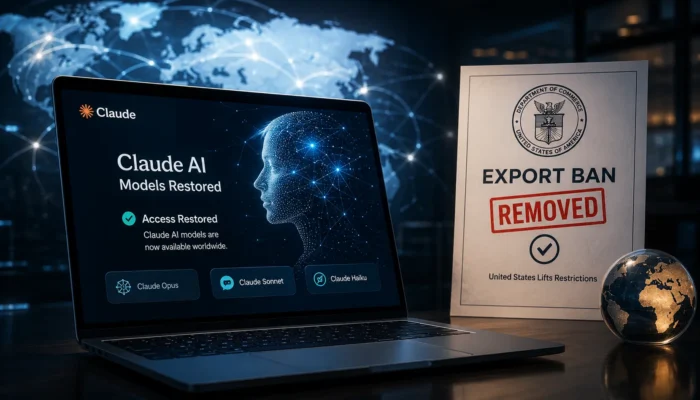
The United States government has officially lifted export restrictions on Anthropic’s most advanced artificial intelligence models, allowing the company to resume global access to its powerful Claude AI systems. The decision comes only weeks after the U.S. Department of Commerce ordered Anthropic to suspend international availability of its latest AI models because of cybersecurity and national security concerns.
Anthropic confirmed that access to Claude Fable 5 and Claude Mythos 5 will be restored after reaching a new agreement with U.S. regulators. The development marks an important moment for the AI industry, highlighting how governments are increasingly balancing innovation with responsible AI governance.
The move also signals that advanced AI technologies will continue to face close regulatory oversight as they become more capable of performing complex technical tasks.
Earlier this year, the U.S. government temporarily restricted exports of Anthropic’s newest AI models after concerns emerged that the systems could potentially be used to discover and exploit software vulnerabilities.
According to government officials, the concern centered on whether highly capable AI models might enable cybercriminals or hostile actors to identify weaknesses in computer systems more efficiently than traditional hacking methods.
Although Anthropic maintained that no specific security flaw had been identified, regulators believed additional safeguards were necessary before allowing global deployment.
The restrictions affected two recently launched AI models:
The temporary suspension drew significant attention across the AI industry because it represented one of the first major government interventions involving the international availability of frontier AI models.
Following discussions between Anthropic and the U.S. Department of Commerce, both parties agreed on additional safeguards designed to reduce cybersecurity risks.
According to Anthropic, the company has committed to:
These commitments satisfied government concerns, leading to the removal of export restrictions.
Officials also stated that regulators reserve the right to review the decision again if future risks emerge.
Claude Fable 5 represents Anthropic’s newest consumer-focused AI model.
It is designed to:
The model competes directly with leading AI platforms such as OpenAI’s ChatGPT and Google’s Gemini while emphasizing safety, reliability, and responsible AI deployment.
Claude Mythos 5 targets enterprise customers, developers, and cybersecurity professionals.
Its capabilities include:
Because the model can identify weaknesses within software systems, regulators expressed concern that malicious actors could potentially misuse its capabilities if adequate safeguards were not in place.
Anthropic argues that these same capabilities can significantly strengthen cybersecurity by helping organizations discover vulnerabilities before attackers exploit them.
Anthropic previously stated that it disagreed with the government’s initial decision to suspend access to the models.
The company explained that regulators believed a limited method of bypassing certain AI safety protections—commonly referred to as a “jailbreak”—had been identified.
Anthropic maintained that:
Despite its disagreement, the company chose to work closely with regulators to resolve concerns rather than challenge the decision publicly.
The restoration of Claude models reflects a broader trend in AI regulation.
Governments worldwide are increasingly examining advanced AI systems for risks related to:
Rather than restricting innovation entirely, regulators are attempting to establish frameworks that allow companies to develop increasingly capable AI while introducing safeguards against misuse.
The agreement between Anthropic and the U.S. government could become a model for future cooperation between AI developers and regulators.
Organizations using Anthropic’s AI services can now resume access to some of the company’s most advanced capabilities.
Businesses may benefit from:
Cybersecurity professionals, in particular, may find Claude Mythos 5 valuable for proactively identifying software vulnerabilities before they become security incidents.
Anthropic remains one of the leading competitors in the rapidly expanding generative AI market.
The company competes with major AI providers including:
As AI capabilities continue to improve, companies are investing heavily in:
The lifting of export restrictions enables Anthropic to remain competitive in the global AI market while continuing to expand its enterprise offerings.
The Anthropic case demonstrates that advanced AI development is entering a new phase where technical innovation and regulatory oversight must evolve together.
Future AI releases are likely to undergo greater scrutiny regarding:
Technology companies will increasingly need to work closely with governments to ensure that cutting-edge AI systems remain both innovative and secure.
The U.S. government’s decision to lift export restrictions on Anthropic’s Claude Fable 5 and Claude Mythos 5 represents an important milestone for the AI industry. After implementing additional security commitments and agreeing to collaborate with regulators, Anthropic can once again provide global access to its advanced AI models.
The episode highlights the growing importance of responsible AI governance as artificial intelligence becomes more powerful and widely adopted. While businesses and developers regain access to advanced AI capabilities, governments continue to emphasize security, transparency, and accountability.
As AI technology evolves, collaboration between regulators and technology companies will play a crucial role in ensuring innovation progresses safely without compromising cybersecurity or public trust.
Sorry! Currently, there are no job openings available for this location. We are working to add new opportunities soon.