
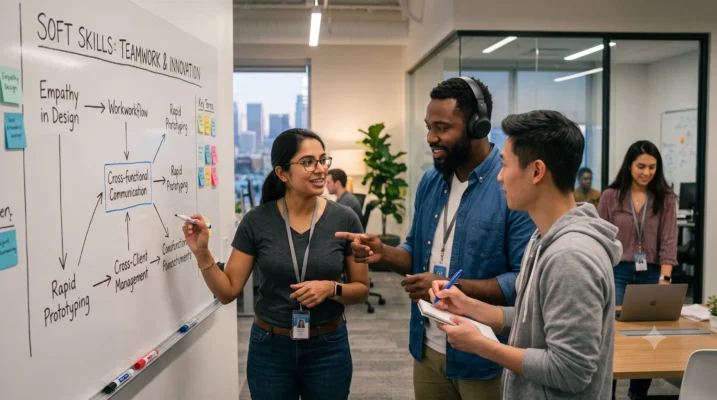
Artificial Intelligence is transforming the technology industry faster than ever before. Tasks that once required hours of coding, debugging, and testing can now be completed in minutes using advanced AI-powered development tools. While AI continues to improve software development productivity, one question is becoming increasingly important: What makes a technology professional truly irreplaceable?
The answer lies beyond technical expertise. Today’s employers are looking for professionals who combine technical knowledge with strong soft skills that AI cannot easily replicate. Skills such as communication, leadership, strategic thinking, problem-solving, adaptability, and decision-making are becoming just as valuable as programming languages and cloud certifications.
As AI evolves into a coding partner rather than simply a productivity tool, professionals who know how to collaborate with AI while applying human judgment will continue to lead innovation.
Modern AI systems can generate code, write documentation, automate testing, and even recommend architectural improvements. However, AI still struggles with areas that require human understanding, including:
Organizations increasingly value professionals who can bridge the gap between technology and business outcomes.
One of the biggest differences between experienced professionals and AI is the ability to define the right problem before attempting to solve it.
AI can generate thousands of solutions, but humans decide which problem deserves attention in the first place.
Professionals who excel at breaking down complex challenges into manageable solutions remain highly valuable across industries.
Generative AI often produces responses that appear correct but may contain hidden inaccuracies, security risks, outdated practices, or logical inconsistencies.
Strong professionals don’t simply accept AI-generated answers.
Instead, they:
Critical thinking has become one of the most important skills in AI-assisted software development.
Modern software engineering increasingly requires professionals to explain technical concepts clearly to both technical and non-technical audiences.
Communication is no longer optional it’s a competitive advantage.
Rather than replacing engineers, AI is increasingly becoming another member of the development team.
Instead of writing every line of code manually, engineers are becoming supervisors of AI-assisted development.
The future belongs to professionals who can effectively manage both people and AI systems.
Technology evolves rapidly, and AI is accelerating that pace even further.
Adaptability allows professionals to evolve alongside technology rather than compete against it.
Curiosity has become one of the strongest indicators of long-term success.
Curiosity encourages experimentation and drives innovation, helping organizations discover smarter ways to solve complex business challenges.
AI-generated code still requires human oversight.
As organizations adopt AI at scale, governance skills become increasingly valuable.
Future software professionals may oversee numerous AI assistants simultaneously.
Managing AI workflows requires organization, prioritization, and operational thinking—skills that remain uniquely human.
Employers increasingly evaluate soft skills during interviews through practical problem-solving exercises rather than technical assessments alone.
These behaviors showcase maturity, accountability, and sound engineering judgment.
Resumes should highlight achievements that demonstrate collaboration and business impact, not just technical expertise.
Employers increasingly value measurable business outcomes over technology lists.
Artificial Intelligence is changing how software is built, but it is not replacing the need for human expertise.
Rather than competing against AI, professionals who learn to guide, supervise, and collaborate with intelligent systems will become the most valuable contributors to modern organizations.
The rise of AI marks a significant shift in the technology industry, but it does not diminish the importance of human talent. Instead, it redefines the role of technology professionals by placing greater emphasis on judgment, creativity, communication, and leadership.
While AI can accelerate software development and automate repetitive tasks, it still relies on humans to define goals, evaluate outcomes, ensure quality, and make strategic decisions. Professionals who cultivate strong soft skills alongside technical expertise will remain indispensable in an AI-driven future.
As organizations increasingly adopt AI across development, operations, and business processes, the professionals who thrive will be those who successfully combine technical knowledge with human intelligence—creating solutions that are not only efficient but also meaningful, ethical, and aligned with real-world business objectives.