
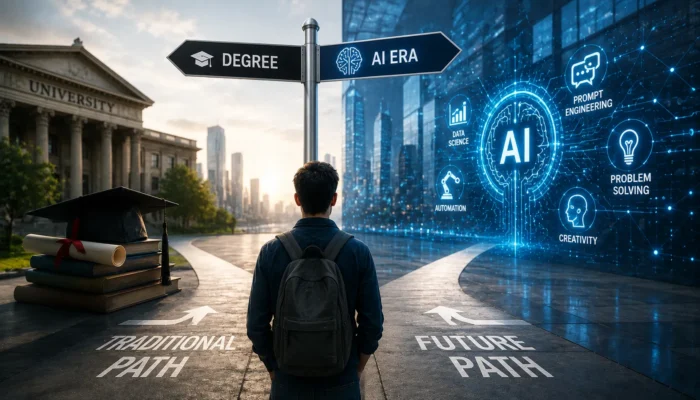
Artificial intelligence has fundamentally changed the software engineering landscape. Generative AI tools such as ChatGPT, GitHub Copilot, Claude, Gemini, and Cursor AI can now generate production-ready code, explain complex algorithms, debug applications, and automate many repetitive programming tasks in seconds. As AI becomes a standard part of modern software development, a growing question is emerging among students, employers, and technology professionals alike:
Artificial Intelligence has fundamentally transformed software development. Generative AI tools like ChatGPT, GitHub Copilot, Claude, Gemini, and Cursor AI can now generate production-ready code, explain complex algorithms, debug applications, and automate repetitive programming tasks within seconds. As these technologies become standard in modern engineering workflows, students, developers, and employers are asking an important question: Does a traditional Computer Science degree still hold value in the age of AI?
The answer is yes—but its value has evolved. While AI has reduced the importance of simply knowing programming syntax, it has significantly increased the need for strong engineering fundamentals, system design knowledge, architectural thinking, and problem-solving skills. Today’s hiring landscape is shifting from degree-first recruitment to skills-first hiring, where practical experience, engineering judgment, and the ability to work effectively with AI tools often matter just as much as formal education.
AI has dramatically accelerated software development by automating many routine coding tasks. Developers can now generate APIs, build user interfaces, write SQL queries, create unit tests, refactor legacy applications, and even document code using AI assistants. These capabilities allow engineers to build applications faster than ever before.
However, software engineering extends far beyond writing code. Organizations still rely on experienced professionals to design scalable architectures, optimize performance, ensure security, troubleshoot production issues, and make critical technical decisions. AI can generate code, but it cannot fully replace human judgment when designing reliable systems that support real business operations.
A Computer Science degree is not becoming obsolete; instead, its purpose is changing. Previously, employers often viewed a degree as the primary qualification for technical roles. Today, it represents something much more meaningful—a structured understanding of computing fundamentals that helps engineers solve complex problems beyond what AI can automate.
These concepts become even more valuable when AI is writing much of the code because engineers must still evaluate whether that code is secure, scalable, efficient, and maintainable.
Universities provide structured learning that is difficult to replicate through self-study alone. Students learn the underlying principles behind software engineering rather than simply how to build applications.
These foundations enable developers to diagnose complex issues that AI alone cannot fully understand.
Generative AI has lowered the barrier to entry for software development. Today, many developers without traditional degrees are building SaaS products, mobile applications, open-source projects, and cloud-native platforms using AI-assisted development.
For many employers, these real-world projects demonstrate technical capability more effectively than academic transcripts alone.
Modern hiring practices increasingly emphasize practical ability over credentials. Technical interviews now focus on understanding how candidates think rather than simply testing memorized knowledge.
Instead of asking where a candidate studied, employers are increasingly asking what they have built, why they made certain architectural decisions, how they solved production challenges, and what they would improve if given another opportunity.
AI can generate convincing solutions that are not always correct. As a result, engineering judgment has become one of the most valuable skills in software development.
Writing code is becoming easier. Knowing whether that code should be used is becoming more important.
As coding becomes increasingly automated, employers are placing greater emphasis on broader engineering capabilities that AI cannot easily replace.
Professionals who combine technical expertise with these human-centered skills will remain highly valuable regardless of how AI continues to evolve.
Computer Science programs should evolve alongside AI by preparing students for modern engineering environments rather than focusing solely on programming languages.
Graduates should leave university with both theoretical knowledge and practical experience building production-ready software.
Whether pursuing a university degree or learning independently, aspiring developers should build a strong foundation in both technical fundamentals and practical engineering skills.
Most importantly, students should continuously build real-world projects that demonstrate their ability to solve practical business problems.
The rise of Artificial Intelligence does not signal the end of the Computer Science degree it marks a transformation in what employers value. While AI can generate code faster than ever before, it cannot replace deep architectural thinking, systems knowledge, engineering judgment, or the ability to solve complex real-world problems.
The most successful professionals in the coming years will combine strong computer science fundamentals, hands-on project experience, and AI-assisted productivity. Rather than competing against AI, they will learn to collaborate with it, using intelligent tools to accelerate development while relying on human expertise to design scalable systems, evaluate technical trade-offs, and deliver reliable software. In the age of AI, the engineers who thrive will not simply write code they will understand how software works, guide intelligent systems, and solve the challenges that automation alone cannot