
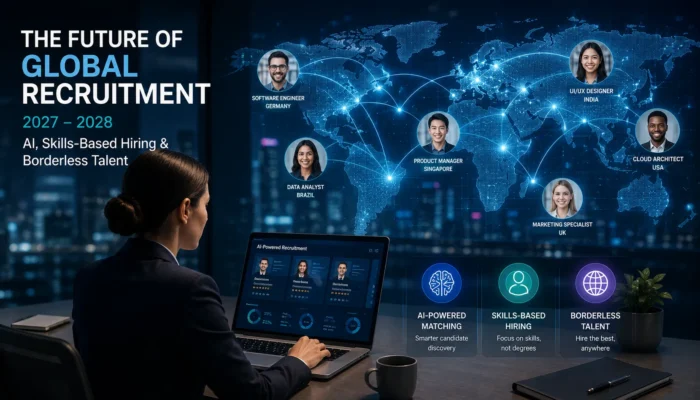
The global recruitment industry has entered one of its most transformative and dynamic phases. Between 2023 and 2026, organizations gradually adopted artificial intelligence (AI), evolving work models, and collaboration tools. Enterprises are now preparing for disruptive talent acquisition models that are more intelligent, skills-focused, responsive, and borderless. Recruitment is no longer limited to filling vacancies; it has evolved into a strategic function that influences business growth, innovation, customer satisfaction, and competitive advantage.
By coming years 2027–2028, enterprise would be turning aggressive for onboarding highly skilled professionals having smart intelligence in Artificial Intelligence, Cloud Computing, Cybersecurity, SAP, Data Engineering, Healthcare, Semiconductor Design, Robotics, Green Energy, and Digital Transformation. The automation would involve simplify repetitive recruitment tasks; human expertise will remain revolve around leadership potential, cultural fit, emotional intelligence, and long-term business alignment.
According to the World Economic Forum, disruption and changing business models in technological domains will enforce reshaping of employment model worldwide, with growing demand for digital and analytical skills. As per the analysis done by LinkedIn and McKinsey & Company highlighted that enterprises are seamlessly shifting toward skills-based hiring and AI-enabled recruitment processes to improve the gap in skilled resource shortage
Numerous connected and mesh networks are driving transitions in recruitment and some of them are as follows:
Artificial Intelligence offers consolidated platform to sourcing candidates, matching skills with job requirements, predicting candidate success, scheduling interviews, generating personalized communication, and analyzing hiring metrics instead of only resume screening.
Instead of replacing recruiters, AI augmented its capabilities by reducing repetitive tasks. It helped recruiters to dedicate their focus on relationship building, strategic hiring, employer branding, and workforce planning.
However, organizations must also ensure that AI systems are transparent, regularly audited, and supported by human oversight to minimize unintended bias and improve fairness in hiring decisions.
The most expected transformation during 2027–2028 would be to see the continued rise of skills-based hiring.
Enterprise level recruiters are leveraging platforms to shift their assessment mechanism from academic qualifications to practical experience, certifications, project portfolios, coding assessments, industry credentials, and demonstrated competencies.
The assessment mechanism shifts both employers and candidates.
Enterprise is now leveraging diverse talent acquisition, management and training tool to match professionals’ continuous skill enhancement and their assessment.
The digital transformation acceleration, continuous learning using digital transformation acting as a must have career requirement rather than an optional advantage.
The shock of Covid 19 pandemic and successful testing of remote work fundamentally changed the global hiring processes as it is reducing around 40% of the operation cost and reducing the infrastructure cost. The enterprise is moving from local level talent acquisition to global level with successful testing of remote work. It will help them to work in global environment,
The collaboration, cloud computing, secure communication, and digital project management thread of Technology platform have significantly reduced the time to conclude international hiring.
Even though new challenges related to international law related to employment law, taxation, payroll administration, immigration, cybersecurity, and data privacy. Enterprise would be enhancing their ecosystem for stronger governance frameworks to manage cross-border employment effectively and efficiently.
Under competitive environment in both blue- and white-collar professional market, Enterprise would be competing both on compensation and reputation level.
As sum up, recruitment marketing and employer branding turning into strategic business investments instead of traditional HR activities.
Enterprises with strong employer brands typically experience better candidate engagement, lower recruitment costs, and improved employee retention.
It’s a known fact that AI present significant productivity enhancement along with new challenges,
It’s being observed that successful enterprises are in the process of combining AI with experienced talent acquisition resources rather than depending purely on technology.
Multiple industries are expected to experience high demand for skilled resources given the dynamic change of global economic environmental change. The Industrial segment such as IT shall continue to focus their recruitment on AI engineers, Cloud Architects, Cybersecurity specialist, SAP Consult, Blockchain, Software Developers and Data Engineer
Information Technology will continue recruiting AI engineers, cloud architects, cybersecurity specialists, SAP consultants, DevOps professionals, and data engineers.
Healthcare organizations will observe technological transition, especially in Operation and Management which would lead to exponential demand in medical professionals, healthcare technologists, biomedical researchers, and digital health specialists.
Manufacturing companies will speed up recruitment in automation engineers, robotics experts, semiconductor professionals, and industrial AI specialists.
Financial institutions will keep focus on cybersecurity, regulatory technology, AI governance, fraud analytics, and digital banking talent.
In Parallel, Global Capability Centers (GCCs) are going to increase significantly, creating immense opportunities for extensively experienced and skilled professionals across engineering, finance, analytics, and shared services.
Enterprises adopting AI-powered, skills-based and borderless recruitment, their strategies lie with measurable gain, competitive advantages. Recruitment is turning out to be strategic and tactical business positioning that contributes directly to productivity, innovation, and revenue growth.
Traditional recruitment processes consume week to months to zero in qualified resources for the position without any surety of joining whereas leveraging AI helps in AI-powered sourcing, automation, interview, skill assessment to professional onboarding. often require several weeks or even months to identify and onboard qualified candidates. It allows recruiters to focus on candidate engagement and hiring decisions. Enterprise which gets successful in shortening hiring process are positioning themselves to secure high-demand talent well in advance of competitors and minimize productivity losses and improve revenue per employee
The upcoming recruitment process would rely heavily on data-driven decision-making. AI-supported and driven resume matching, behavioral, skills evaluations, and workforce analytics help recruiters to mark down professionals whose skills align with both current and future business requirements.
The onset of borderless recruitment to recruit specialists from regions where critical skills are more readily available are helping business to reduce cost of resources and improve revenue generation per employee. Companies are now not limited to compete squarely within local markets but enterprises are now building geographically diverse teams that operate across multiple time zones.
While the benefits are compelling, recruitment transition are influencing new risk also which require proactive management.
AI should not support human judgment. Organizations must establish governance frameworks that ensure recruitment algorithms remain transparent, fair, and regularly reviewed.
Responsible and deeply monitored AI governance will become a characteristic of employers during 2027–2028.
Recruitment and its associated digital personal information is closely associated data pointers such as resumes, assessment results, employment history, identification documents, and interview feedback.
Enterprises operating in India must be following the regulatory compliance set forth by Ministry of Electronics and Information Technology’s implementation of the Digital Personal Data Protection framework, while multinational businesses should also consider privacy obligations under regulations such as the General Data Protection Regulation (GDPR).
Strongly monitoring privacy controls not only reduce legal risk but also strengthen employer trust and brand reputation.
The automated AI continuously and routinely do recruitment activities, demand for uniquely human capabilities continues to grow.
Even though it is very difficult to automate but should act as key differentiators in the future workforce.
Looking forward, several indicators are clearly showing the expected trends which will shape the next phase of global recruitment.
It’s evident that AI is going to be part of every stage of talent acquisition which includes planning to onboard level. Talent acquisition resources shall be using AI copilots to execute market intelligence, candidate recommendations, and predictive workforce insights.
Enterprises are evaluating cutting edge technologies and allocating capex to invest more heavily in internal mobility by following existing employees who can transition into emerging roles.
Hiring decisions will increasingly be based on verified skills, certifications, project experience, and demonstrated capabilities rather than job titles alone.
Cross-border collaboration will continue to normalize as organizations build distributed teams supported by cloud technologies, digital collaboration platforms, and standardized global hiring processes.
Candidates are likely to evaluate employers not only on salary but also on organizational purpose, learning opportunities, leadership quality, flexibility, diversity, well-being, and digital employee experience.
Measure recruitment success using quality-of-hire, retention, and business outcomes rather than hiring volume alone.
As recruitment evolves into a strategic business capability, organizations require partners that combine recruitment expertise, technology understanding, and market intelligence.
DigitalXnode supports organizations by helping them modernize talent acquisition while adapting to changing workforce dynamics.
DigitalXnode focuses on helping clients reduce hiring timelines, improve candidate quality, strengthen employer visibility, and build scalable recruitment processes aligned with long-term business objectives.
Rather than treating recruitment as a transactional activity, DigitalXnode works to position talent acquisition as a strategic enabler of business growth, digital transformation, and organizational resilience.
The coming years for global recruitment are not defined solely by technology but it will be governed by how organizations integrate technology with human intellect. Artificial intelligence will continue to improve efficiency level, but success would lie with strategic decision-making, ethical governance, strong employer branding, and meaningful candidate relationships.
Skills-driven resource selection will broaden access to talent, while borderless recruitment will enable organizations to overcome geographic limitations and compete in an increasingly interconnected global economy.
Organizations that invest today in responsible AI adoption, workforce development, recruitment analytics, and employee experience will be better prepared for the opportunities and challenges of 2027–2028. Those that remain dependent on traditional hiring models may struggle to attract critical talent in an increasingly competitive labor market.
For businesses seeking to transform recruitment into a strategic competitive advantage, partnering with experienced organizations such as DigitalXnode can accelerate modernization, improve hiring outcomes, and help build a future-ready workforce capable of supporting sustainable growth.