
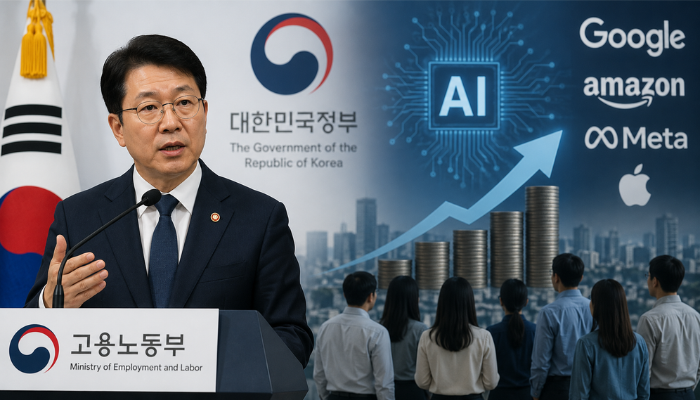
Kim Young-hoon, South Korea’s Labour Minister, made a public demand that major companies should begin to dividend their massive AI sector profits among their employees, suppliers, and subcontractors. If companies do not share the earnings, the economic gap will grow as the profits will overwhelmingly consolidate in the hands of large monopolistic corporations.
In an interview with Reuters, Kim stated that companies, like Samsung Electronics, which surpass their profit goals, should begin to refund a portion of their earnings for the year. Positive annual profits are indicators that companies are succeeding, and as a result, those companies owe a financial reward to their employees, business partners, and the local community in which the company operates.
Kim’s claim earned him a personal invitation to refine his ideas for a contract with the government, the major businesses, labor unions, and the suppliers to grow an acceptable means for accessing what Kim called “excess profits.” Kim the former labor activist, and a newly appointed member of the Lee Jae Myung administration, received national attention after he successfully mediated a last-minute wage settlement with Samsung Electronics. This settlement upended a planned strike and awarded the employees’ of Samsung’s Memory Chip a significant annual bonus.
The AI boom’s impact on the average South Korean citizen and rising corporate profits
For many South Korean politicians, the aftermath of the global boom in AI technology, and especially in semiconductor technology, presents a modern-day dilemma of how to ethically distribute the wealth created by the technology.
“We must develop new ways to distribute through social dialogue,” said Kim. He explained that Samsung’s successes could not have been achieved by the managerial and labor force alone, as it also required the support of a network of some 1,700 suppliers and of the local communities that provide the indispensable resources of water and electricity.
Samsung Electronics and SK Hynix had a great increase in their profits due to the rapid growth in the demand in the market for AI-based technologies. Samsung has in fact already announced that it will award special bonuses to its employees should the company’s operating profits be in excess of 200 trillion won in the years 2026 to 2028.
Kim has for the first time publicly unveiled his idea of discussing what should be done about excess corporate profits in late May and is arranging to hold a forum to that effect. In his interview with Reuters, he provided examples of how he believed this surplus should be shared by, among other things, changing the prices of contracts with suppliers to offer more support to smaller enterprises.
His proposal has sparking backlash from the conservative opposition People Power Party, because they think his proposal would be too much government interference in the market and would violate the principles of a free market economy.
The presidential office did not comment on Kim’s statements, though it has given its approval to a public discourse about the matter. In his comments, a senior policymaker also said that since AI technologies are likely to create a surplus tax revenue, this money can be used to create a dividend for citizens.
Neither Samsung Electronics nor SK Hynix commented on the minister’s proposal.
Reacting to feedback, Kim claimed his proposal was not communism. He argued that using some additional profits on suppliers and workforce initiatives will make the supply chain more robust and competitive and aid in sustainable economic growth.
He argued paying suppliers more and supporting workforce initiatives for smaller firms offset gaps in the labor market. Many workers in South Korea aspire to work for the large conglomerates due to the large differences in wages and benefits. Kim warned South Korea’s large companies will continue to fall further behind as they will be the only ones able to afford large performance bonuses.
In South Korea, the inequality gap between the top and bottom 20% of households has stretched farther than in the last 6 years. Kim argued that increased inequality caused South Korea’s economy to stagnate
Kim explained to the press why he intervened in wage negotiations for Samsung. It is usually unheard of for a South Korean labor minister to be directly involved in negotiations, however, Kim said that both Samsung and union representatives requested help after repeated negotiations broke down and an 18-day strike that otherwise would have caused a large negative impact on the economy and the financial markets was inevitable.
Kim said that both sides lacked extensive experience in labor negotiations because of Samsung’s historically no-union policy. It was especially hard to figure out how to fairly distribute large company profits to everyone.
Kim said he mentioned to President Lee that his experience in the labor movement would help him build trust and open lines of communication between management and the workforce. It also has implications for labor relations.
Analysts suggest that Samsung striking a deal with its union could mean other labor organizations will try and get better deals from their respective employers, too. Kim said he does not plan on interfering in every labor dispute, but he did say a richer framework is needed to help labor unions and employers address salary issues in the future. Kim pointed to other issues troubling Samsung, namely employee dissatisfaction with the pay disparity between employees in the memory-chip division and employees in non-memory chip divisions.
Talented employees are the lifeblood of any company, and in order to retain them, Samsung has to find a way to manage the pay discrepancies. Kim warned that these imbalances could result in the loss of talent in areas of the company that are yet to be very competitive.