
AI technology changes rapidly. New versions and capabilities appear at an unprecedented pace. During this time, consumers continue to stress about the technology’s influence on the work that they do.Many people worry about AI because it can automate jobs across multiple industries. Unlike previous technologies, modern AI can perform complex tasks once handled by humans. Customer service, administration, software, content, and finance work are all at risk. Companies develop and deploy new AI tools every day.
Major corporations have all the incentive in the world to invest in and implement these tools.
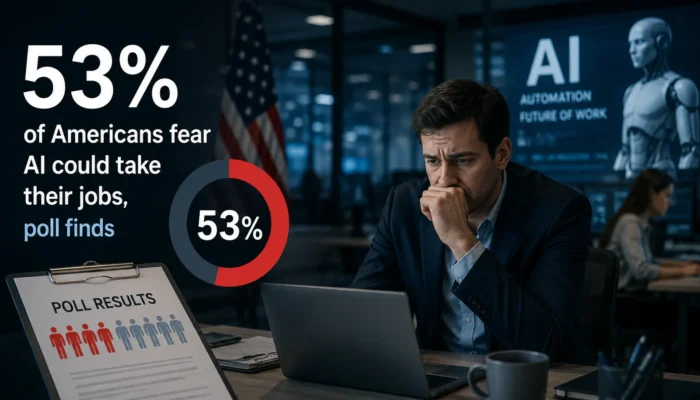
Reuters surveyed 4,531 adults over six days. The results showed that 53% worry AI could affect their ability, or a family member’s ability, to find work. These results are indicative of the influence of the rapid pace of working AI technology on the general public’s perceptions of work and economic certainty.
There is great concern all across the United States about employment. This survey reported that 37% of Americans believe that AI will not take away their jobs, and an unclear portion of respondents were uninterested or unable to choose a side. The remaining respondents were all worried.
Americans understand that AI can automate many workplace tasks.Many companies actively promote automation to improve productivity. As a result, workers see more examples of AI replacing routine tasks. These initiatives make workers fear job losses and major changes to workplace tasks.
Layoffs linked to automation and increased AI investments have intensified public concerns. Intuit is one example often cited in discussions about AI and employment. The company announced layoffs affecting 17% of its workforce while increasing investment in AI technology.
Even though organizations claim that AI eliminates mundane tasks and creates new roles, the public continues to be apprehensive, as the purpose of automation is easily recognizable to employees. Many employees cannot see the benefits of automation, as they are too far off in the future.
Former Alphabet CEO Eric Schmidt has contributed to the debate about AI’s impact on society and employment. Schmidt’s views on the transformation caused by AI are shaping the debate around job loss vs job creation caused by AI.
The Reuters/Ipsos survey found that Democrats express greater concern about AI-related job losses than Republicans.
The results show that 61% of Democrats vs. 47% of Republicans in this survey are worried about AI and employment. Analysts believe this difference exists because many highly educated Democrats work in industries where AI is more likely to automate tasks.
All over the political spectrum are concerns that AI will disrupt jobs and cause social issues. These are the signs of the concerns growing nationally, not just in politics.
AI’s effect on the labor market is troubling to many people, and that is evident in this survey. Jennifer Schalhoub is a 62-year-old freelance writer from Little Ferry, New Jersey. She previously earned income by writing letters for government-related purposes. She is concerned that writing jobs are now difficult to come by and businesses now prefer using AI to create writing for them.
Many freelance writers and creative professionals fear AI could disrupt their careers. Companies can now create content faster and at a lower cost with AI tools. It is true that companies will be tempted to use AI, justifying its use by arguing that the results will be of the same quality, creativity, and value as what is being done by a seasoned pro.
Creating content that is of the same quality, creativity, and value as what is being done by a seasoned pro will help show what AI is capable of, but there are still so many restrictions that are already limiting what AI can do.
People have been worrying about AI for longer since the rise of generative AI in 2022. With sophisticated AI programs that can talk to you, write, code, and do tasks, Advanced Conversational AI introduced a vast amount of people to AI.
The success of generative AI sparked intense competition among technology companies. As a result, organizations worldwide invested heavily in AI development.
Now, AI is being used to sell to customers, help with the development of software, aid in marketing and research, analyze data, and much more. Generative AI can perform many repetitive tasks efficiently. Consequently, some companies may reduce hiring for entry-level or routine roles.
Most experts agree that using Generative AI will transform the way people work, but people will still keep their roles. Employees who use Generative AI effectively may become more productive and valuable to their organizations.
The survey also looked at the differences of AI use by Americans. People in the U.S. with advanced education used AI far more than people in the U.S. with less education.
About 50% of people with degrees use AI, and about 33% of people without degrees use AI. Overall, about 40% of Americans use AI.
As AI becomes more common in daily life, public attitudes may gradually change. Some people will continue to feel threatened by AI. Others will welcome its ability to improve productivity and create opportunities.
Not having a job is not the only thing the public is worried about. Polling shows 73 percent of respondents are worried about AI in general, a number that is increasing in surveys from the past.
Concerns extend beyond employment. People worry about AI-generated misinformation, privacy risks, cybersecurity threats, and military applications. Many people believe existing regulations and safeguards have not kept pace with AI development.
Faster development with less control increases possible risks with greater liability on governments, businesses, and society.
There is really no way to know what the future holds as concern and usage of AI has rapidly increased, especially in the workplace. Every other time a large shift in tech advancement has happened, many businesses have closed, leaving formerly employed people to start new businesses.
Creating new systems to help people adapt to AI safeguards its risks, and will be the best way to manage the technology. Jobs that involve collaboration with AI will remain important. Roles requiring creativity, emotional intelligence, and critical thinking are also likely to remain in demand.
This new economy forces businesses, schools, and policymakers to develop programs to train and equip workers to be successful in a workforce augmented by AI.
The Reuters/Ipsos survey highlights growing concerns about AI in the United States. More than half of respondents worry about job displacement, while many also express broader concerns about AI’s rapid advancement. The American public is anxious as AI integrates itself more and more in the day-to-day.
AI has the ability to create tremendous productivity and growth within the economy, but there are daunting issues surrounding the future of work and the changing workforce. Companies using AI need to consider the challenges of supporting workers to both innovate and ensure that the positive effects of AI are enjoyed by as many people as possible.